English
  Spanish
  French
  Russian
  Arabic
You’ve probably noticed this before: you’re waiting at a red light even though there’s no traffic on the other side.
That’s because most traditional traffic lights run on fixed-time programs. Every signal has a pre-set duration (for example, 30 s green, 5 s yellow, 25 s red), regardless of how many vehicles are actually there.
But what if the traffic light could “see” that there are no cars and react faster?
That’s the idea behind actuated signal control.

What does “actuated mode” mean?
An actuated traffic signal uses detectors — sensors in the pavement, radars, or cameras — to sense if vehicles or pedestrians are waiting.
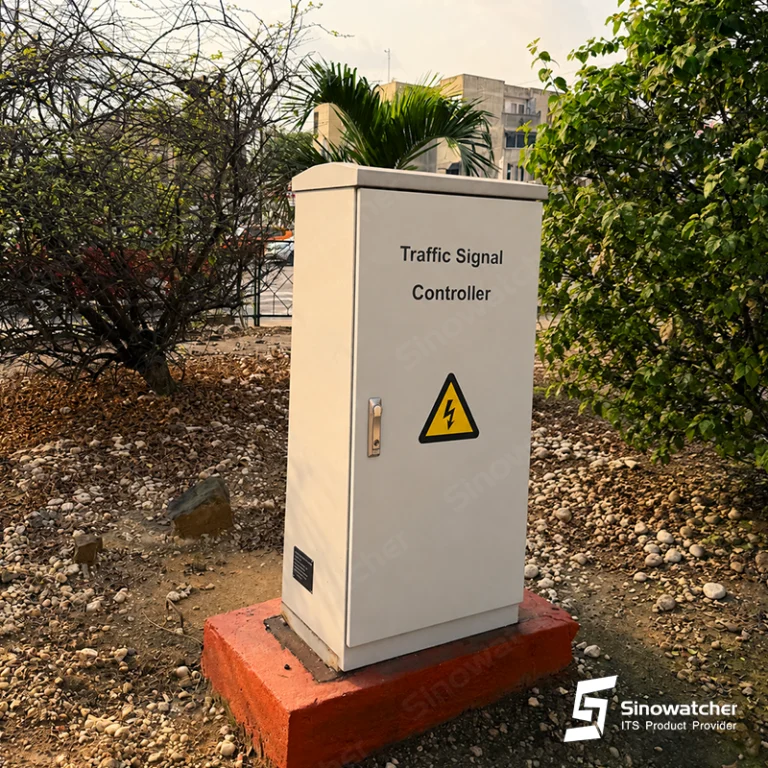
The traffic controller (the system’s “brain”) then decides when and for how long to give the green light to each approach.
Instead of following a fixed clock, the system thinks:
- If vehicles are still arriving, keep the green on.
- If there’s no demand, switch to the next phase.
Three ways to control an intersection
| Control Type | How It Works | Advantages | Limitations |
| Fixed-time | Repeats identical cycles all day long. | Simple, reliable. | Not responsive to real traffic. |
| Actuated | Adjusts green time according to detected demand. | Reduces delay, improves flow. | Needs detectors and setup. |
| Adaptive | Coordinates many intersections through a central system using network data. | Highly efficient city-wide. | Complex and expensive. |
In simple terms, actuated control is the smart middle ground between fixed-time and fully adaptive systems.

A simple example
Imagine a main avenue and a side street.
Traffic is steady on the main road but occasional on the side.
When no vehicle is waiting on the side street, the main road stays green.
When a vehicle stops over the detector, it sends a message to the controller: “Vehicle waiting here!”
Once the main road finishes its minimum green time, the controller changes the phase to let the side street pass.
Result: zero wasted time.
What does the system need to “think”?
The controller bases its logic on three types of information:
- Presence: Is there a vehicle detected?
- Demand: How many requests are pending for that phase?
- Timing: Are the minimum and maximum limits satisfied?
In fixed-time systems, everything depends on the clock.
In actuated systems, everything depends on real traffic conditions.

Visible benefits
- Shorter waiting times during off-peak hours.
- Lower fuel consumption and fewer emissions.
- Smoother traffic at low-volume intersections.
- Ability to react to incidents or irregular flows.
Therefore, actuated control was the first real step toward intelligent traffic management.
Its idea is simple but powerful: not every intersection has the same traffic, and not every green should last the same. With a few sensors and smart timing rules, signals can adapt to what’s actually happening on the road.
In the next chapter, we’ll explore which sensors and timing parameters make this possible — and how a traffic light “decides” each second whether to stay green or turn red.