English
  Spanish
  French
  Russian
  Arabic
Now that you know an actuated signal can “see” cars and adapt in real time,
You might be wondering:
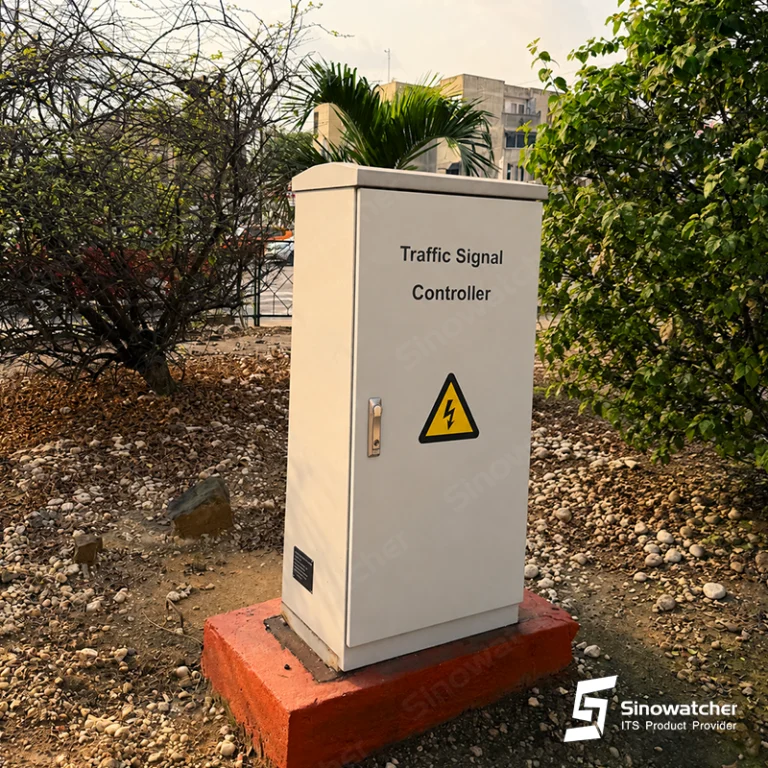
How does it actually do that? What’s inside the controller, and what do those mysterious sensors really do?
Let’s open the black box and explore the main components and parameters that make an actuated system intelligent.

1. The Detectors — The Eyes of the System
Detectors are the key elements that let the signal understand the real-world traffic situation.
They can sense when a car is present, how fast it’s moving, or whether it has already cleared the intersection.
Common detector types
| Type | How it works | Typical use |
| Inductive loop | A coil embedded in the pavement detects changes in the magnetic field when a car passes. | Widely used, accurate, durable. |
| Video camera | Uses image processing to detect vehicle presence or queue length. | Flexible, easy to install. |
| Microwave/radar | Sends waves and measures reflections to identify moving vehicles. | Works well in rain and snow. |
| Magnetometer / wireless sensor | Detects magnetic changes, often wireless and battery-powered. | Modern option for quick installations. |
The purpose is simple: to know if and when a vehicle is waiting or passing.
2. Where are detectors installed?
- On minor (secondary) streets
Usually placed 1–2 meters before the stop line, so when a car stops, the sensor immediately sends a “call” to the controller.
If no vehicle is detected, that phase is skipped — no wasted green time. - On major (primary) streets
Placed farther upstream (10–30 m from the stop line) to measure approaching traffic flow.
This helps decide whether to extend or end the current green.
Minor approaches request green. Major approaches keep green as long as cars keep coming.

3. The Parameters – The Brain’s Rules
Each actuated controller follows a set of timing parameters that define how it reacts to detections.
Think of them as “reflexes” — fast rules that decide whether to continue, shorten, or switch phases.
| Parameter | Meaning | Typical Range | Purpose |
| Minimum Green (Gmin) | The shortest green duration is guaranteed for a phase. | 5–10 s | Clears the initial queue safely. |
| Maximum Green (Gmax) | The upper time limit for the green. | 30–60 s | Prevents one direction from monopolizing the intersection. |
| Extension (Unit Green) | Extra time is added when a vehicle is detected during green. | 2–3 s | Keeps the light green while vehicles are arriving. |
| Gap (Critical Headway) | Max interval allowed between vehicles before ending green. | 3–4 s | Decides when “flow has stopped.” |
| Delay | Ignores very brief detections to avoid false triggers. | 0.5–1 s | Filters noise or short gaps. |
Together, these parameters make the controller react like a “reflex”:
If cars keep coming → extend; if no cars appear → change.
4. How the logic flows
You can imagine the signal’s thought process like this:
- Start green:
Begin timing the minimum green (Gmin). - During Gmin:
Vehicles can arrive, but no extension yet. - After Gmin:
Each detection within the gap adds one “unit extension.” - If the gap exceeded:
No car detected → phase ends. - If Gmax reached:
Even if cars are still coming → force a switch to the next phase.
This simple but powerful logic balances efficiency and fairness.

5. Example in real life
Imagine a side street with a queue of cars waiting.
As the phase turns green, the controller starts counting Gmin (say, 7 seconds).
Each car that crosses during that time “resets” a short timer — the gap timer.
If another car appears before it expires, the green continues; if not, it switches to red.
Result: The light stays green only as long as cars keep arriving.
Conclusion
Actuated signals combine sensors and smart timing rules to manage traffic efficiently — especially where flow changes throughout the day.
They respond to real conditions instead of a clock, helping drivers spend less time waiting and making cities move more smoothly.
In Chapter 3, we’ll dive into how the controller actually decides when to extend or shorten the green, how it gives priority to main streets, and how it coordinates with pedestrians and public transport.