English
  Spanish
  French
  Russian
  Arabic
In our previous post, we deconstructed the severe physical limitations that traditional video traffic detection faces on urban streets – focusing heavily on how dynamic occlusion (large trucks blocking small cars) and starlight dynamic range pose catastrophic data failures for adaptive signal control.
To solve these visual headaches, a traffic vehicle detection system cannot simply rely on standard security components. It must evolve into a highly specialized edge-computing hub. Today, we dive into how hardware-driven Edge-AI and algorithmic innovation change the game, pushing the boundaries of what optical detection can achieve through Sinowatcher’s Video Vehicle Detector.
1. Video Vehicle Detector Performance in Low-Light Conditions
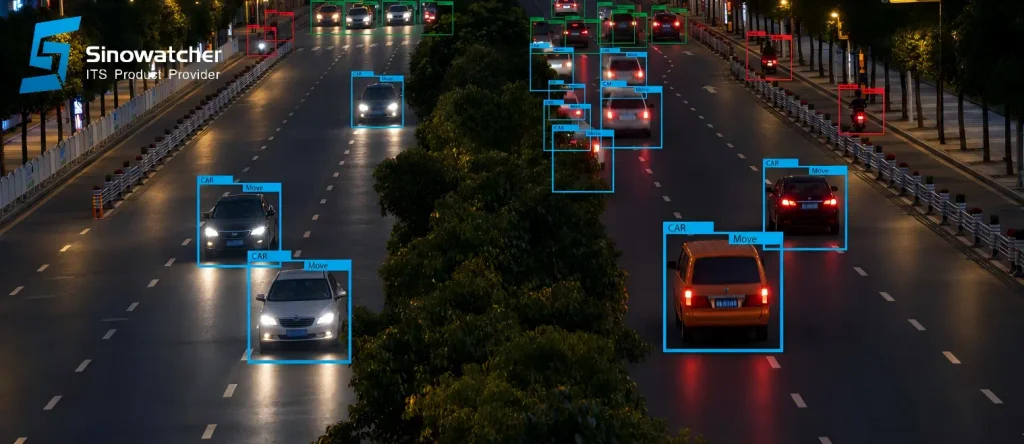
The ST-VD5 completely bypasses the limitations of standard surveillance hardware by adopting a premium 1/2.5” CMOS 5-Megapixel Starlight-level image sensor.
- Conquering Dark Routes: With a minimum illumination threshold down to 0.0001 Lux in black-and-white mode, it “sees” clearly even on unlit or poorly illuminated urban roads where traditional algorithms fail due to headlight glare.
- Localized Processing: Backed by an internal NPU (Neural Network Acceleration Chip) running deep learning algorithms, it processes data locally with ultra-low latency, ensuring a comprehensive detection rate of ≥ 95%
Traffic Occlusion Detection with Blind Area Compensation Algorithms
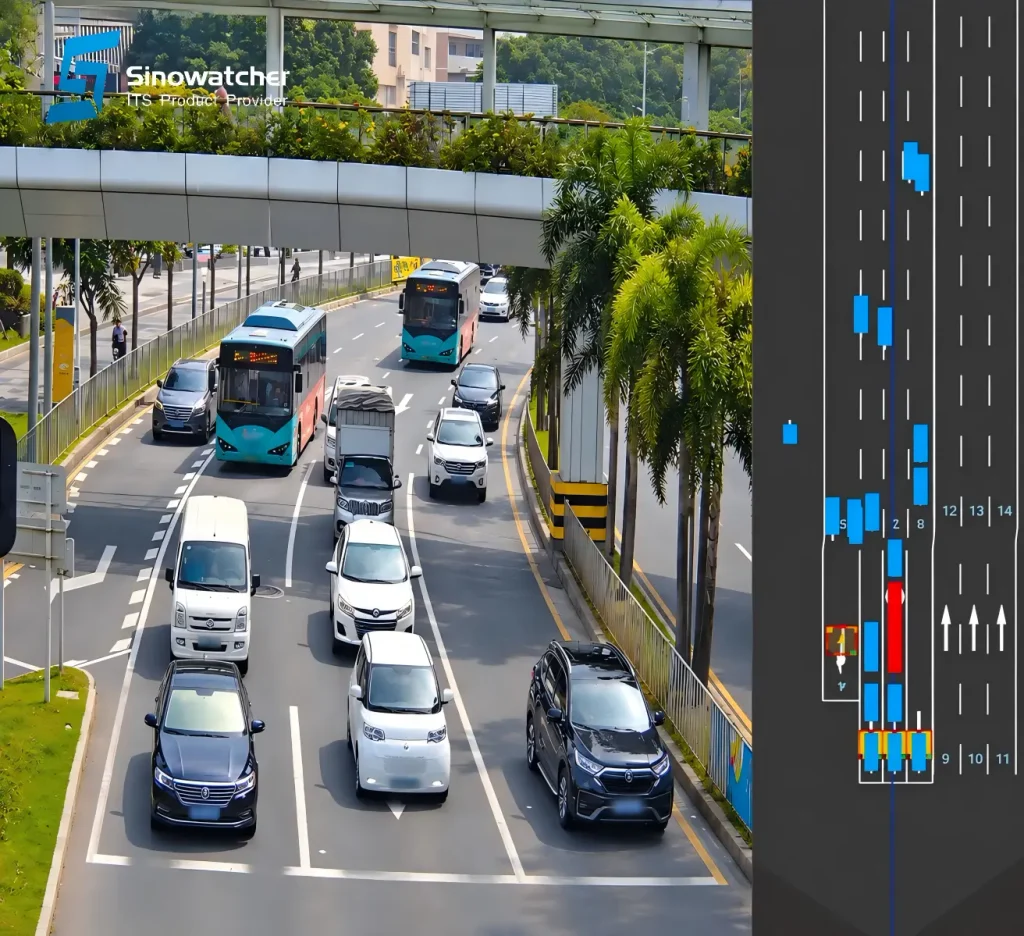
To counter the “large vehicle blocking” flaw that has long plagued municipal traffic counts, the Video Vehicle Detector features a sophisticated Blind Area Compensation Algorithm.
Instead of treating the road as a flat 2D plane, the system sets up precise entry coordinates (head entering) and exit coordinates (tail leaving) across the detection cross-section. By logging these cross-sectional timestamps, the system mathematically deduces whether a smaller vehicle is stopped within the occluded zone behind a truck.
This pushes lane queue length accuracy to ≥ 90%, supplying traffic signal controllers with the exact data needed to optimize adaptive green waves and prevent localized spillback.
2. Advanced Video Vehicle Detector Classification for Urban Traffic Analysis
Rather than lumping multi-modal traffic flows into a single, undifferentiated data stream, the video vehicle detector executes real-time classification across a highly defined urban taxonomy, isolating passenger cars, heavy freight trucks, transit buses, and two-wheelers. Simultaneously, the edge processor maps out critical operational analytics, generating continuous datasets for spatial occupancy, temporal occupancy, and vehicle headway.
| Feature / Metric | ST-VD5 Capability | Value to ITS System Integrators |
| Detection Distance | 80-100 meters (covers up to 4 lanes) | Fewer devices needed per intersection; massive cost savings on hardware. |
| Integration Protocols | GB28181, ONVIF, RTSP, GAT920 | Seamlessly plugs into existing urban platforms without proprietary headaches. |
| Field Resilience | IP66 Weatherproofing & -40°C to 70°C tolerance | Zero-maintenance operations under blistering heat or freezing blizzards. |
3. Video Vehicle Detector Installation and Field Deployment Optimization
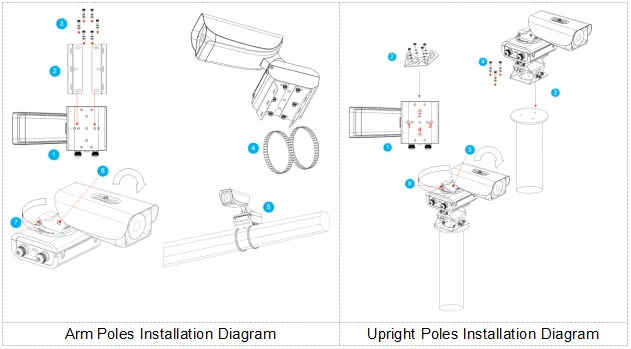
High-spec software loses its value if a device takes hours to align or easily drifts out of position. The Video Vehicle Detector features a dual-dimension independent adjustment design (horizontal rotation + tilt). This mechanical innovation allows field engineers to quickly and precisely align the camera’s 3 detection cross-sections with physical lane lines, completely eliminating traditional installation blind spots.
4. Radar-Video Fusion for All-Weather Traffic Detection
While Edge-AI algorithms and starlight imaging technologies have significantly improved optical traffic detection performance, vision-based traffic detection systems still face limitations in extreme low-visibility conditions such as heavy snow, dense fog, sandstorms, or poorly illuminated highway environments.
To achieve more stable all-weather traffic detection across complex multi-lane roads and high-speed corridors, the industry is increasingly moving toward multi-sensor approaches that combine video analytics with radar traffic detection technologies.
Radar-video fusion enables vehicle detection systems to maintain more reliable tracking continuity, detection stability, and traffic data collection under conditions where optical sensing alone may be insufficient.
As intelligent transportation systems continue to evolve, multi-sensor traffic detection is expected to become an important direction for next-generation smart traffic management.
At Sinowatcher Technology Co., Ltd., we are also preparing to introduce a new radar-video fusion vehicle detection solution that integrates radar sensing with AI-powered video analytics for enhanced traffic detection performance in complex real-world environments. Additional information about this solution will be shared in future updates.