English
  Spanish
  French
  Russian
  Arabic
At Sinowatcher, we are committed to creating safer, more intuitive mobility systems for modern urban environments. Recently, our pedestrian crossing solutions have been implemented in the Middle East, upgrading a series of busy intersections that had long struggled with limited nighttime visibility, unclear crossing boundaries, low compliance among both pedestrians and drivers, and a lack of unified control logic between devices; with accessibility support and guided signaling, crossing safety relied mostly on users’ individual judgment.

To address these challenges, we deployed a fully integrated pedestrian crossing solution that transforms the location into a coordinated, high-visibility environment designed to guide predictable behavior for all road users.
Challenges Before the Upgrade
Before deployment, the intersection presented several persistent risks: visibility declined sharply during nighttime hours, drivers and pedestrians lacked clear boundaries defining the crossing path, signaling devices operated independently rather than as a synchronized system, and inclusive features for visually impaired individuals were insufficient. These circumstances led to hesitation, inconsistent decision-making, and unsafe crossing events, especially during peak periods and late-night traffic.

Our Integrated Smart Pedestrian Solution
Our solution introduced a unified ecosystem of Sinowatcher smart mobility devices operating under synchronized logic to support coordinated signaling and guided movement throughout the intersection.
Smart Integrated Traffic Lights for Vehicles and Pedestrians
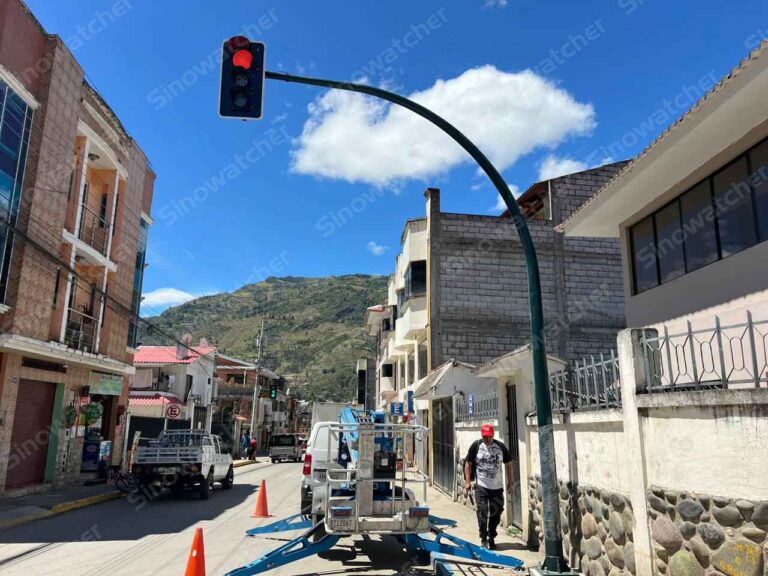
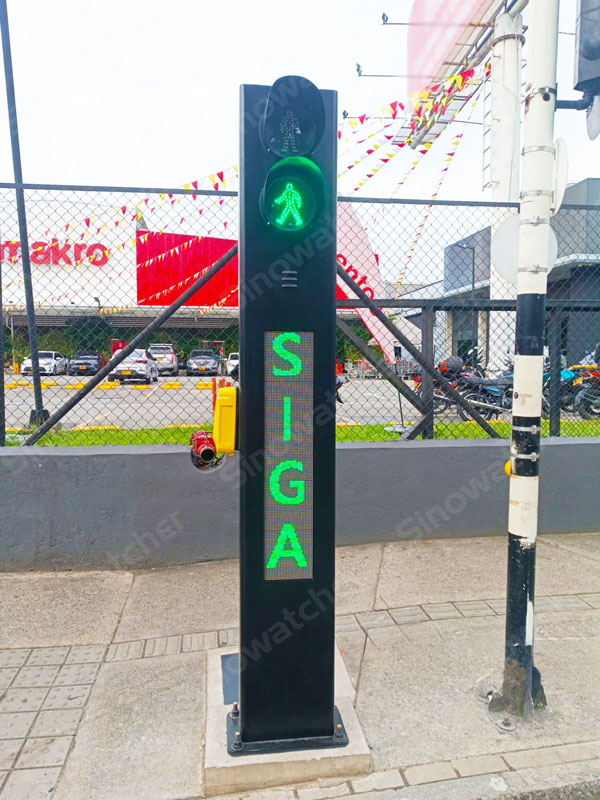
For vehicle traffic, the system incorporates full-ball red, yellow, and green signals supported by a vertical LED bar that displays countdown progress through gradual light reduction, improving driver awareness and enabling smoother flow. For pedestrians, the system provides red-green pedestrian signals with two-digit countdowns, vertical LED bars aligned with pedestrian phases, blind-audible units that enhance accessibility, and projection lamps that cast walk or stop symbols directly onto the zebra crossing. Together, these visual and audio cues offer clearer behavioral guidance at eye level and ground level.
Road Studs for High-Visibility Crossing Boundaries
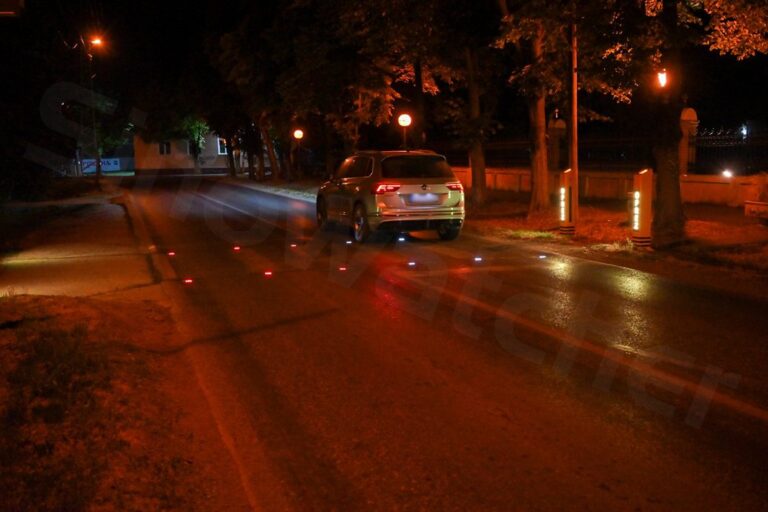
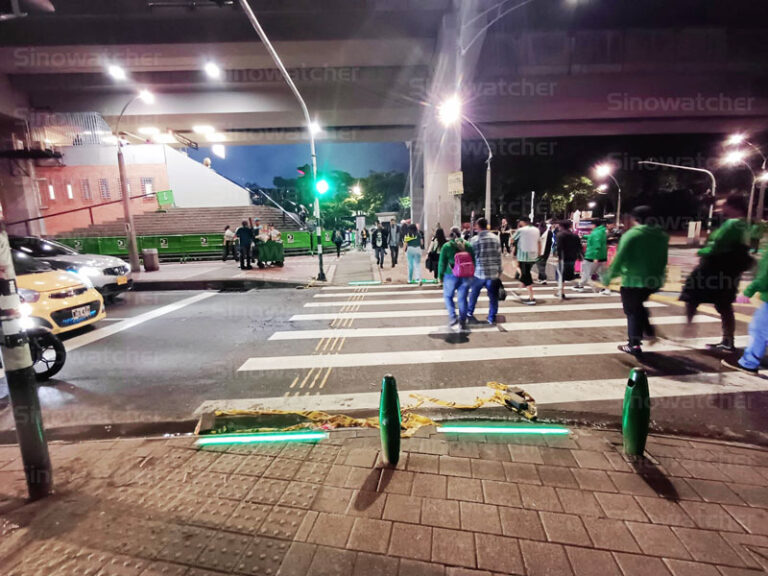
To enhance visibility, especially at night, LED road studs were installed along the crossing path, displaying synchronized red or green signals on both vehicle-facing and pedestrian-facing sides. This creates early visual warnings for approaching drivers and helps pedestrians maintain proper lane alignment while crossing.
Smart Pedestrian Warning Bollards for Safety Enforcement
Sensors embedded in smart pedestrian warning bollards detect pedestrians entering during red phases and trigger real-time audio alerts via waterproof speakers, while high-brightness displays show corresponding signal icons or text. By issuing timely preventive warnings, the system discourages unsafe crossing attempts before they occur.
Contactless Pedestrian Push Button for Inclusive Interaction
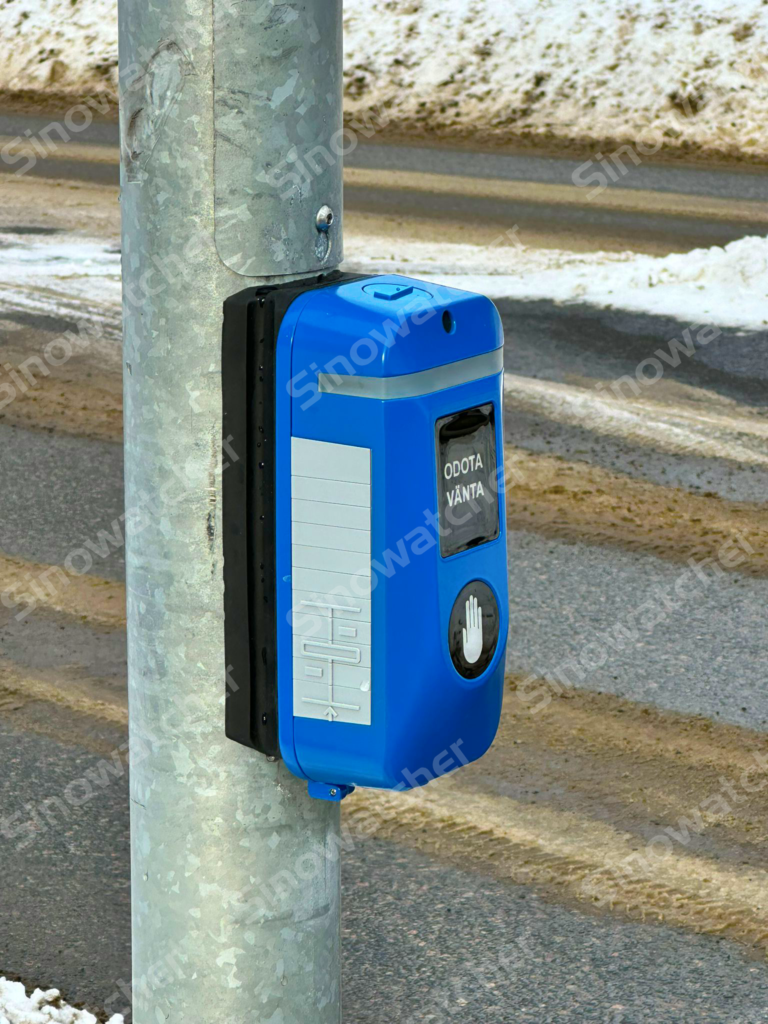
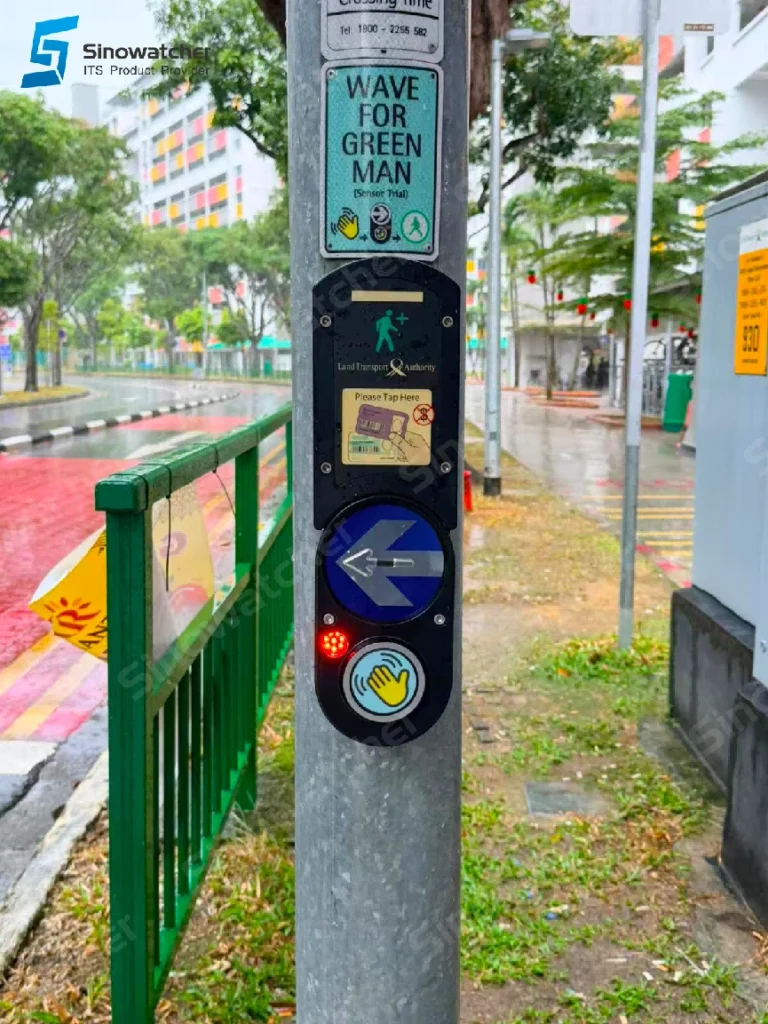
Users can request crossings through a capacitive, contactless push button that activates within 5-10 cm, offering a hygienic, glove-friendly, and accessible interface that integrates countdown timers, visual indicators, and audio guidance. This ensures instant feedback without the need for physical contact, supporting both public hygiene and universal design requirements.
Measurable Improvements in Safety and Efficiency
Post-deployment results demonstrate higher pedestrian compliance due to synchronized multimodal cues, increased driver awareness enabled by illuminated boundaries and projection lighting, improved night time safety, enhanced accessibility for visually impaired users, reduced conflict and hesitation at the crossing point, and smoother traffic flow driven by coordinated countdown signals. The intersection now functions as a guided environment where user movements are more predictable and secure.
Why System Integration Matters
This project reinforces our belief that safety improves when infrastructure actively guides user behavior instead of leaving interpretation to individuals. Through system-level integration, mobility becomes intuitive rather than reactive, visibility becomes central to design, and technology promotes safer choices rather than simply monitoring them. The deployment represents a shift from traditional traffic signaling toward interactive, user-centric urban mobility.
Looking Ahead
Sinowatcher remains committed to helping global cities accelerate pedestrian safety enhancements through scalable, data-driven, and inclusive solutions. Each installation brings us closer to urban spaces where movement is not only possible but safe, clear, and seamlessly connected for everyone. Better signaling drives better traffic – and ultimately, better cities.