English
 Spanish
 French
 Russian
 Arabic

A conventional radar speed display measures a vehicle’s speed and shows the result to the driver. Some models also retain traffic statistics, such as vehicle counts or speed distributions. These summaries can describe general patterns, but they may not show which vehicle produced a particular reading. This distinction matters when a road authority needs more than an overall picture of traffic speed.
In a conventional display, radar data is typically used to provide immediate feedback, and any stored data may remain anonymous statistics. Automatic Number Plate Recognition (ANPR) adds a vehicle-identification step. A camera captures a plate image, recognition software reads it, and the system can associate that result with radar speed and time when the modules are correctly integrated. This changes the purpose of vehicle speed data collection: records can describe individual vehicle passages as well as road-level trends. The exact functions – such as storage, search, export or remote access—depend on the selected product configuration.
That difference also affects what drivers see. A conventional display communicates speed or a warning; an ANPR radar speed display may also show the recognized plate, making the feedback more specific. Achieving this requires the camera, radar, display and processing unit to work together. The value therefore comes from a coordinated system, not simply from adding a camera.
The following sections trace the change from the roadside message to the data a traffic team can use, then explain the system and selection checks that make those functions dependable.
How Does ANPR Change Speed Feedback?
When several vehicles pass at once, the system must decide which speed to display. A common rule is to prioritize a vehicle currently detected as speeding; if no vehicle is speeding, it may show the vehicle closest to the sign. If a plate is displayed or recorded, the system must associate it with the same radar target. This target-selection step is essential to reliable vehicle speed data collection, because a correct speed paired with the wrong plate creates a misleading record.
Showing a plate beside a speed warning may help a driver recognize that the message refers to their own vehicle and that the event may have been recorded. This can make feedback feel more direct, but it does not guarantee a reduction in speed. Placement, visibility, recognition success and road conditions all influence the effect. Project owners should also check local requirements before displaying or retaining plate information.
The camera must capture a readable image under the actual site conditions. Vehicle speed, camera angle, distance, plate size in the image, exposure, lens focus and night illumination all matter. A specification such as total camera resolution cannot alone show whether plates will be readable at the intended distance and speed.
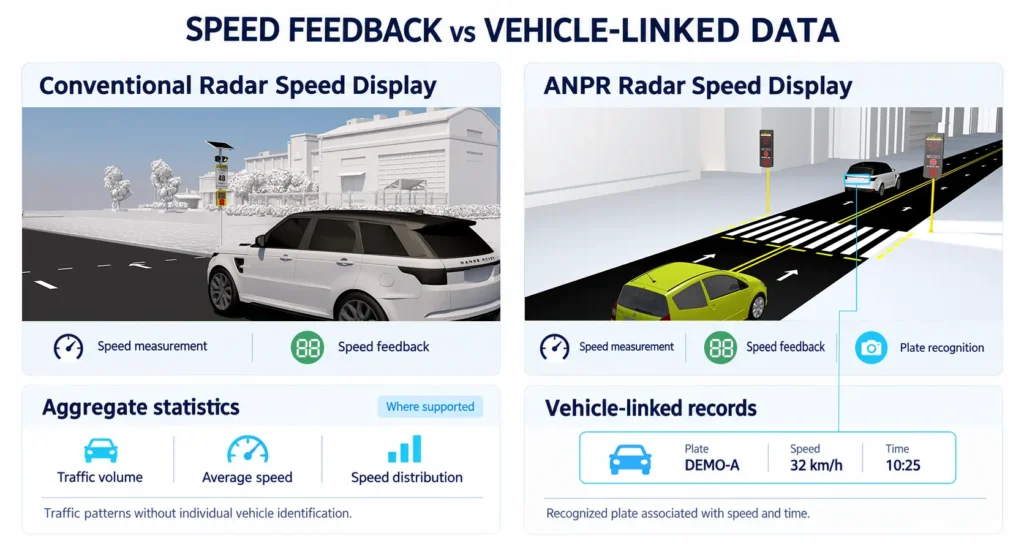
Once feedback refers to a specific vehicle, the same identification can also change how traffic data is reviewed. The value depends on linking the right information consistently.
From Individual Records to Useful Traffic Information
The main benefit of linking these fields is that a traffic team can examine a specific passage in context. Once the plate, speed and passage time are correctly linked, managers can review more than anonymous totals. Depending on system functions and permissions, records may help identify periods with frequent speeding, select events for further investigation, or compare speed patterns before and after a road-safety measure. License plate recognition for traffic monitoring is most useful when the plate is matched to the correct vehicle event and the project has a defined operational purpose.
These records support investigation; they do not explain a speeding pattern by themselves. Road design, traffic volume, lighting, weather, speed limits and field observations may all help explain why speeds are high at a particular time or location. Data is most useful when it guides teams toward a focused site review rather than replacing one.
Vehicle-linked information also needs clear governance. Before deployment, define what data is necessary, who can access it, how long it is retained, and how it is exported or deleted. Some projects need only counts or speed bands and may not need identifiable records. The scope of license plate recognition for traffic monitoring should match the project purpose and applicable local requirements.
These data uses place demands on the equipment. The camera, radar and display must exchange information in a coordinated way, or the system may show or store mismatched results.
How System Integration Shapes Performance
The information chain begins at the roadside, where each component performs a different task. An ANPR radar speed display may combine several independent modules: radar measures speed, the camera captures an image, recognition software returns a plate, and the display provides feedback. A processing unit must coordinate their outputs. Integration therefore includes compatible communication protocols, synchronized timestamps, trigger timing, data formats and the match between a radar target and its plate image.
Protocol compatibility is only the first requirement. Buyers should check whether the system can configure modules consistently, match data at the roadside, store records locally and report faults. Edge computing can support local processing, while local storage can preserve records when the network is unavailable. These capabilities help make vehicle speed data collection dependable and manageable after installation.
Remote management adds a site-connectivity question. Confirm whether a suitable network exists and whether the equipment supports it. If not, a gateway or communication module may be required. Also establish what functions remain available during an outage, how data is buffered, and how synchronization resumes when the connection returns.
Because performance depends on the complete chain, selection should check both component specifications and real operation at the installation site.
What Should Buyers Check Before Selecting a System?
Camera and recognition: Camera choice should follow the road geometry and the plate formats in the target market. Confirm supported plate formats, recognition distance, lane coverage and image quality at expected speeds. Ask for test results under conditions similar to the site, including daylight, night lighting, backlight, glare and weather. Request the test speed, lighting, lane count and sample size; resolution or a single accuracy figure is not enough to assess fit.
Radar and target selection: The radar must measure the intended vehicles and provide a predictable target rule. Check operating range, accuracy, detection distance and angle. Ask how the radar chooses among multiple vehicles, whether speeding targets take priority, and what the display shows when none is speeding. Confirm how the system responds if the plate cannot be read or the speed-to-plate match is uncertain.
Display and driver readability: Feedback must be visible early enough for drivers to respond safely. Select digit size, brightness, color and layout for the road speed, viewing distance and mounting angle. Check daylight and night readability, glare, outdoor protection and power consumption. If plates appear on screen, test legibility at realistic distances and confirm that the display rule follows the target-selection logic.
Processing, storage and connectivity: Data features depend on both local processing and the site’s communications. Confirm module protocols, local matching, edge processing, storage, unified configuration and fault reporting. For remote functions, check network availability, gateway needs, platform interfaces, security and offline behavior. Verify which functions are included in the quoted configuration and which require extra equipment or services.
Field testing should verify the complete chain under representative traffic conditions, because bench tests cannot reproduce every lane, lighting or traffic scenario. Check radar detection, camera capture, plate recognition, speed-to-plate matching, display behavior, storage and export. Include multiple vehicles and day and night operation, then agree on acceptance criteria and data-handling procedures before installation.
Conclusion: Choose a Complete, Verifiable System
An ANPR radar speed display extends conventional speed feedback by linking a vehicle identity to a speed event, when the system is configured to do so. That link can create more specific roadside feedback and richer traffic records, but it depends on accurate target selection, readable images and reliable integration.
For road authorities and integrators, the key selection question is whether the complete system fits the road environment and management objective. Evaluate the camera, radar, display, processing, storage and connectivity together, then verify them in a field test. This approach helps ensure that vehicle speed data collection produces useful, correctly matched information and that the product can be managed at the deployment site.