English
  Spanish
  French
  Russian
  Arabic
We carry supercomputers in our pockets and stream high-definition video from almost anywhere on earth. Yet, millions of us still sit at dead-red lights with absolutely zero cross-traffic in sight. Why? Because the system controlling that intersection was programmed for a world that no longer exists.
For decades, traditional traffic control has relied on a simple formula: fixed-time schedules, inductive loops buried in the asphalt, and eventually, standard video cameras acting as “virtual loops.” While video detection was a major step up from cutting up the road, it still relies on a lot of guesswork. To achieve true traffic signal optimization, we need more than static triggers. Perhaps this worked when cities were smaller and traffic patterns were predictable. But today? It’s costing municipalities billions in lost economic productivity, increasing carbon emissions, and driving citizens crazy.
The “guess and wait” era is over. It’s time to bridge the gap between heavy-duty municipal hardware and modern smart traffic systems. Let’s break down exactly how next-generation AI traffic management compares to traditional traffic control, why it doesn’t require dismantling current systems, and why it’s the future of urban mobility.

The Problem: The Limits of Reactive Infrastructure
If you’re a traffic engineer or city planner, you know the headache. Traditional traffic control, even with cameras, is inherently reactive.
- Fixed-Time Plans: You run studies, try to achieve traffic signal optimization manually every year, and hope traffic behaves. It rarely does.
- The “Virtual Loop” Limitation: Cities moved away from expensive, easily broken inductive loops to smart video detectors. These integrated cameras are great at basic volume analysis. However, they still essentially function by drawing “virtual loops” or detection areas on a screen. They only activate the signal when a vehicle crosses that specific pre-drawn pixel line. This severely limits true adaptive traffic signal control
- The Ripple Effect: When an accident happens or a concert lets out, traditional controllers at isolated intersections can’t communicate with the grid to flush the traffic. They only know a car is waiting right now, not that a massive platoon is coming in two minutes. The result is gridlock.
We don’t need more traditional detectors. We need predictive intelligence to build proactive smart traffic systems.
The Solution: AI Traffic Management
AI traffic management doesn’t replace the traffic controller. It acts as the ultimate, hyper-intelligent coordinator for traffic signal optimization. Here is the technical reality of how it operates:

- The Perception Layer (Seeing the Whole Picture)
While standard video vehicle detectors provide essential data like traffic flow and occupancy time, advanced AI shifts this from localized detection to deep corridor perception. Using high-definition computer vision and 4D radar, the system maps exact vehicle trajectories and approach speed up to 800 feet upstream, rather than just waiting for a car to hit a virtual loop. - The Edge Compute Layer (Zero Latency)
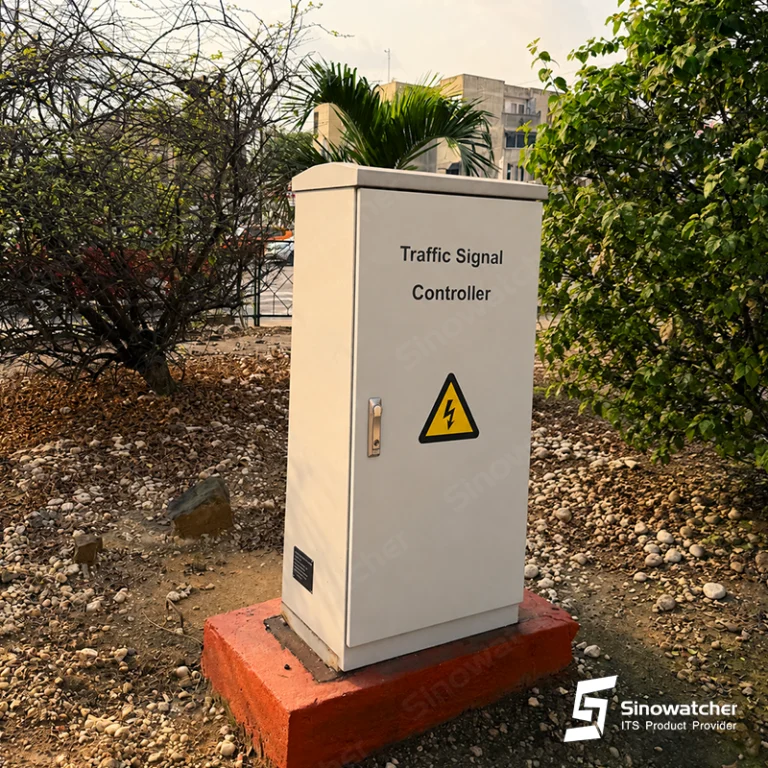
You cannot run real-time intersection logic on a cloud server; the latency and risk of connectivity dropouts are too high. Instead, heavy-duty edge computing units are installed right inside the cabinet. They process the raw video/radar data locally in milliseconds, which enables real-time adaptive traffic signal control without lag. The Fail-Safe: If the network goes down, the edge device still feeds local data to the controller. Safety is never compromised. - Hardware Integration (The Handshake)
The AI system is hardware-independent and integrates seamlessly with existing traffic controllers worldwide to power robust smart traffic systems. Communicating via globally recognized standard IP and serial protocols, it acts as a universal plug-in. The local controller remains the absolute authority over safety matters (managing conflict monitors, pedestrian safety distances, and red-light intervals), while the AI simply sends dynamic, real-time requests to extend or end green light phases based on actual traffic demand. - The Logic Layer (Predictive vs. Reactive)
Traditional systems wait for a vehicle to hit a detector zone; in contrast, AI uses Deep Reinforcement Learning (DRL) to predict. If Intersection A knows a platoon of 40 cars just cleared, it alerts Intersection B to adjust its cycle length before the platoon arrives, creating dynamic green bands across entire corridors. This is the pinnacle of traffic signal optimization.
Translating Tech into Street-Level Results
By overlaying predictive AI onto reliable hardware, we can extract maximum capacity from our existing rights-of-way, proving that AI traffic management is vastly superior to older, static methods.
| Feature | Traditional Traffic Control | AI Traffic Management |
| Adaptability | Fixed or slowly actuated. Updates take years. | Real-time, second-by-second dynamic adjustments. |
| Detection Style | Virtual loops or physical asphalt loops. | Trajectory tracking, deep object classification. |
| Coordination | Isolated or rigid corridor plans. | Network-wide, predictive optimization. |
| Approach | Reactive (responds when a car hits the zone). | Predictive (adjusts timing before the platoon arrives). |
- For City Planners & Traffic Authorities: Wave goodbye to sending crews out for manual turning movement counts. You gain round-the-clock intersection analytics that help slash daily commute times, lower your municipality’s carbon footprint, and power continuous traffic signal optimization.
- For Hardware Manufacturers: The future is synergy. As city planners transition to smart traffic systems, the demand for hardware that seamlessly integrates with AI brains for advanced adaptive traffic signal control has never been higher.
For Drivers: Fewer stops. Less idling. Getting your time back.

The Hidden Price of Outdated Intersections
Every day you wait to upgrade your corridors is another day of wasted tax money, unnecessary emissions, and frustrated citizens. The shift toward smart traffic systems is no longer experimental; it is scaling globally.
The question isn’t if AI traffic management will run your city’s intersections. The question is when.
But here is the engineering reality: AI is the future, but it requires a rock-solid physical foundation today. Upgrading your street-level hardware to support true adaptive traffic signal control is the first mandatory step to moving beyond traditional traffic control and future-proofing your grid.

Are your intersections ready for the future?
Let’s get your city moving. [Explore Our Traffic Hardware Solutions] to build a smarter grid today, or [Speak to an Engineer] to plan your next hardware upgrade.